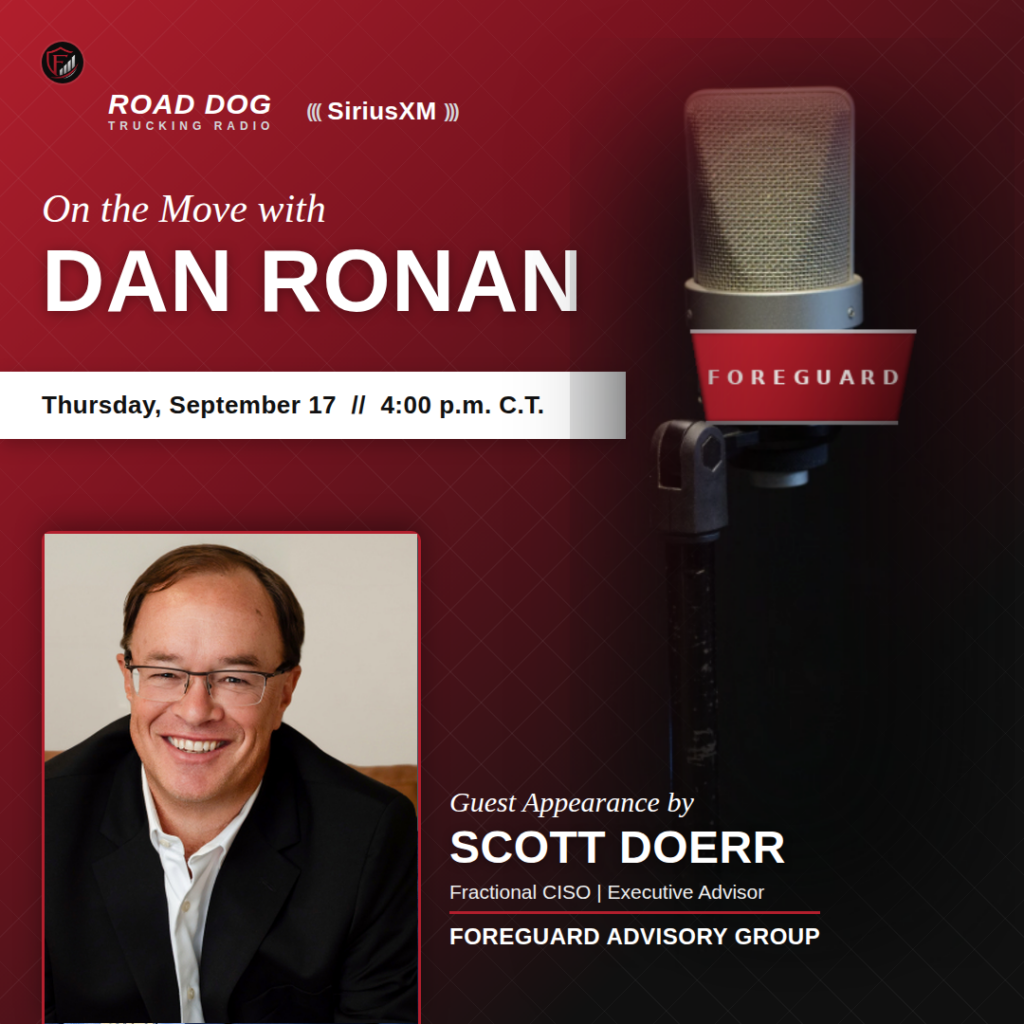
Scott Doerr, founder of ForeGuard Advisory Group, joined Dan Ronan on Road Dog Trucking Radio, SiriusXM’s channel for the trucking industry, for a conversation on cybersecurity, AI, and the risks facing transportation and logistics leaders today.
Driver’s license fraud was the starting point. Even with national driver’s license standards in place for more than two decades, the data has not gotten safer. Companies collect this information and hold onto it far longer than they need to, and once a driver’s license is compromised, it is far harder to replace than a password or a credit card. AI has made that problem worse. A driver’s license image can no longer be trusted as proof that the person presenting it digitally is who they claim to be.
AI is cutting both ways. The same tools that speed up legitimate business are speeding up fraud, deepfake images, cloned voices, and AI-generated documents that are increasingly difficult to distinguish from the real thing. The tools built to detect AI-generated content are now being outpaced by AI systems trained specifically to fool them, which keeps organizations playing defense rather than getting ahead of the threat.
The fix is not more data collection. It is less. Organizations should be asking why they are collecting a given piece of identity data in the first place, whether they actually need to hold onto it, and whether their deletion process actually destroys it rather than just moving it to a digital equivalent of a drawer. Layered security, multi-factor authentication, and modern alternatives like dynamic QR codes, one-time passcodes, and biometrics can verify identity without storing it. Third-party risk management extends that same discipline to every vendor handling this data on a company’s behalf.
One myth Scott addressed directly on air is that smaller carriers are at a disadvantage. They are not, once they bring in the same caliber of expertise large enterprises already have on staff. A fractional cybersecurity leader gives a three or four truck operation enterprise-grade resilience without the enterprise-sized price tag, at a fraction of the cost of a full-time hire. Cyber insurance is part of that conversation too. It is a good safety net, but only if the due diligence behind it holds up when a claim actually gets filed.
Trucking and logistics run on connected systems now. ELDs, dispatch platforms, GPS tracking, and payment systems all sit inside a single operational chain, and a cyber incident anywhere in that chain becomes a business continuity problem, not just an IT problem. That is the kind of board-level risk ForeGuard works with executive teams to get ahead of.
Cyber risk in transportation and logistics is a board-level conversation now, not a back office one. ForeGuard Advisory Group is ready to define the next steps with you.
Listen to the full conversation below.